Showing posts with label books. Show all posts

Sunday, December 17, 2006

Mum, what's a flamethrower for ?

I'd like to pick up on the story from John over at Sinosplice: "Military Weaponry for Kids". By all means, go over and read the whole article (and definitely don't forget to continue on to the link he provides to the Peer-See website about bizarre blocks. I won't link it here: go over and enjoy).

I am not going to explain again here what John has done much more eloquently and ironic than I ever could, but for reminiscence sake, let me just post one of the pictures that can be found in the children's book:


So is this what education in China has come down to: teaching infants how to draw machine guns and write a few characters along the line (note that the entire book has about 35 pages with vocabulary and drawings ranging from flamethrowers over missile launchers to air pistols)? Ever since I saw this article, I have been wondering how this kind of "educational material" would be received in our parts of the world and I am left to think it would be banned outright. The average age of the target audience must be about 5 to 6 years old, for Christ's sake !!! So if I were in a position to do so, I would revoke the business license of the "Beijing Children and Juvenile Publishing House" on the spot, so they wouldn't be allowed to publish anything again, notwithstanding any good stuff they may have published before.

Now I have been reading up on the comments on John's article as well, and I was surprised that not more commenters were flatly denouncing the idea of having this kind of material in a children's teaching book. The reaction sometimes found is this one:

"I think kids just like guns and war and bombs. I remember the first things I drew as a kid were these crazy war scenes. When I was 15 I was out blowing up bottles with my buddy’s .22 and shotgun. As I’m what might be called a pacifist now, all the exposure had little affect."

"Excellent renderings - these books continue the war-theme throughout society. It’s like kids playing cops and robbers, indians and cowboys… everything is the same as before (human emotions, needs, wants), technology changes (weapons of war, fax machine, Internet, phone, television, etc.)".


I totally do agree kids like weapons: in my toddler days (and for quite some years after that), I have been branding plastic swords, firing toyguns, "taken down" hordes of cowboys (since I always wanted to be with the Indians), but what we used were "just" swords and "just" guns. At least for me it was like this. Now I wonder what happens when you start differentiating on the names. I was very impressed with an article from Sam at "The Useless Tree" where he wrote the following on Bush and the war in Iraq:

He can't do anything because he does not have the words to capture the complexity of the situation. To be sure, "civil war" is only an approximation of a multidimensional conflict. But "civil war" is a starting point. Without that concept, there is really no way to dig into the dirty details and find a way out. And that is what reminds me of Confucius:

Naming enables the noble-minded to speak,and speech enables the noble-minded to act. Therefore, the noble-minded are anything but careless in speech.
Analects, 13.3

Bush, of course, is famously careless in speech. And his willful denial of the name "civil war" makes it impossible for him to act.


So, by reversal of this situation, the question for me is: what happens in the kids minds when you give them all the names ? How will they act ? If I were fed with all that different terminology, I am sure I would start to ask what it all is for ? Under which circumstance would I rather use this than that ? I'm looking forward to the answer from the education experts at the Beijing Publishing House to a kid's question what a flamethrower is needed for ? Shall we explain how in Vietnam entire villages were napalmed into oblivion with this equipment ? And how do you explain the use of the silencer, when all kids just adore wreaking havoc with tons of noise ? I bet it will make them sleep real tight if you tell them it is used to kill others in their sleep without waking up Mum and Dad.

For me, I totally agree with Sam that the name itself is a formidable power, albeit applied here in the other way than in his example.

But then I kept wondering why one would ever come up with the idea to have all this military wisdom in a children's book ? And the hypothesis I came up with was brought on to me by the very first comment to John's article:

Little boys like it. I have a poster of military equipment I picked up in a discount bookstore, I’m not sure if it was for kids or not, but now I know how to say things like Apache Attack Helicopter. And if you don’t know how to say something like .50 cal Desert Eagle, you’re lost in CounterStrike.


... you're lost in CounterStrike ... It suddenly struck me that the only reason this kind of stuff was making it into a children's book could be that the gaming industry was already trying to tie their future customers from childhood on, by learning them the vocabulary they would need later in the playing arcades and online. In a country where elementary schools are allowed to make educational trips to ... McDonalds, I would expect this hypothesis to be perfectly possible. The kind of money involved in the gaming business would require recruitment of the players from very early on, and unless someone proves me wrong, I believe this is one of their marketing vehicles. But since China doesn't seem to mind the publication of this kind of materials, I wish them good luck with cleaning up their mess.

Oh, and by the way, there's no harm with having this published in Beijing: all terrorists are located in Xinjiang anyway.


AddInto

Tuesday, December 05, 2006

"Treason by the Book": more than a medieval whodunit


From the day I put down his masterly account of 100 years of Chinese revolution as lived by the leading intelligentsia of the times in "The Gate of Heavenly Peace", Jonathan Spence was an instant hit with me. But he just wandered off after that, meaning I didn't read anything else of this eminent Sinologist, ... till last September, on my recent China-trip, I noticed this book of his I had never heard about before in a bookstore in Shanghai.

"Treason by the Book" (Penguin Books, 2001), in a diminutive sense, could be referred to as some sort of a whodunit but in all is so much more. The story in the words of Laura Rivkin:

The story begins in Xi’an when Zeng Jing’s messenger Zhang Xi delivers a letter to Yue Zhongqi one of Yongzheng’s most trusted generals. The letter asks Yue to rise up against the emperor, but instead Yue immediately arrests the messenger and reports to the emperor. The action quickly moves to Beijing and to the emperor who, from the moment the first despatches arrive from Yue Zhongqi, takes personal control of the investigation. The action follows the continuing search for culprits, their questioning, the final reckoning between Yongzheng and Zeng Jing and Yongzheng’s resolve to teach the people of China the lessons he himself has learned as a result of Zeng’s delusions and successful thought-reform.


The entire process of Zeng Jing's rectification goes on record in the "Awakenings from Delusion" (大义觉迷录) which is subsequently spread in hundreds of thousands of copies over the entire country. The "Awakenings", a philosophical treatise, are largely based on the correspondence between Zeng Jing and the Yongzheng emperor during the former one's captivity in Beijing. The would-be traitor is at the end of process fully pardoned by the emperor who thereby goes entirely against the advice of his counselors.

What was destined to become a mere side note in the Qing history, turned into a heroic effort by emperor Yongzheng (1678 - 1735) to defend his legitimacy, a debate on the still infant legacy of the early Qing as compared to the almost mythical Ming dynasty, a questioning into the status and position of the Confucian scholars of eighteenth century China ... and Spence captures it all beautifully.

With his style of writing, he positions himself somewhere in the twilight zone between the strict requirements imposed on the historian and the narrative freedom of the novelist. Spence the historian has once again dug up tons of material and sources that by it's sheer amount would be enough to scare away anyone with the faintest interest in the subject, but Spence the narrator manages con brio to distill a captivating story out of all this. Siding with none of the involved parties, he takes the reader by the hand and like Alice in Wonderland we are guided through this kaleidoscopic world where words possess still the power they were intended to have, where words and the writings and poetry they feature in are attacked as a result, where Big Brother is watching each and every one through the eye of the collective memory and through the jottings, memoirs and missives of hordes of scholars and officials who meticulously recorded anything that could bear relevance to the administration of the State. Again Laura Rivkin:

From all the thousands of years of official Chinese history, why does Spence choose this particular episode to research and write about? This story is a footnote to the great Qing histories. Although well-known among scholars of Qing history most non-academic Chinese or western scholars of China will probably never have heard of Zeng Jing nor of the great publishing enterprise that was the result of his treason. Qianlong banned the book and ordered all copies to be destroyed. Only a few were saved, buried in archives or by enterprising book collectors.

Spence’s reasons no doubt are many-fold, but for the reader the descriptions and details about the inner-workings of the Qing bureaucracy are fascinating beyond mere curiosity. This story encapsulates the imperial machinations within the Forbidden City, the emperor’s relationships with his provincial commanders, how absolute state control reached down even to the tiniest county town thousands of miles from the capital. But it is also a story about the ordinary people of a huge empire, living in tiny isolated communities where the arrival of a stranger remained in the collective memory for years afterwards, where conversations may still be recalled in precise detail. It was possible for Qing officials, without names, crimes or even proper dates, on the basis of a rheumy memory of an elderly road-side inn-keeper to locate prisoners who had passed through Hunan seven years previously en route to exile in Guangxi province.


The scope of the dynastic histories, the breadth of the (currently still available) material produced several centuries ago seems to foreshadow our urge to capture the world and put it all down in databases. The sheer amount of knowledge that was available, the way it was being shared and distributed is what makes this book a delightful learning experience.

But what has captivated me even more than the description of a highly and well organised society is the person of the Yongzheng Emperor. At the pinnacle of power, he is depicted as a hard working manager amidst a staff of trustees whom he supervises almost on a daily basis and who help him rule the country. Yet by pardoning the traitor who threatened to bring him down, against the advice of his counselors, it seems to me that this First Citizen of Beijing, this Prisoner of the Forbidden City, has tried to reach out for a freedom that was beyond his reach, the freedom to think things over, come to a decision and then act according to it, irrespective of what others think, as in some way Zeng Jing had tried (albeit in vain) by starting his insurgency.

I wonder how Yongzheng would have felt had he known that his son, the famous Qianlong Emperor, notwithstanding his fathers order that Zeng Jing could not be touched, had the traitor captured after all and with his accomplices sliced to death. I know we will never have the answer to this question, but if anybody has an idea, I'll be glad to hear it.


AddInto

Wednesday, November 01, 2006

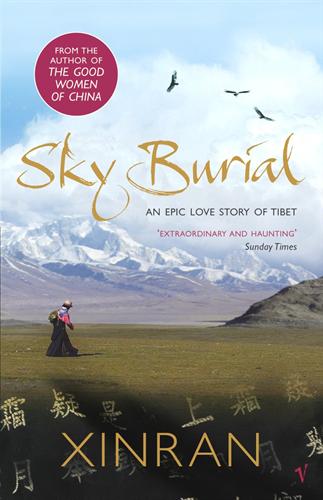
On reading Xinran's "Sky Burial"


I just finished "Sky Burial", the second book by London-based journalist Xinran, who acquired fame for her account of different Chinese women's lives in "The Good Women of China".

In "Sky Burial" she brings the story of another Chinese woman, Shu Wen, whom she met for a few short days in Nanjing, during which she told Xinran about the amazing twist that brought her to live in Tibet for 30 years.

A native of Suzhou, Shu Wen marries Kejun, an army doctor, who is sent to Tibet in the fifties and goes missing soon thereafter. Having only been married for a hundred days, Shu Wen joins the army herself and sets out on a search for her husband whom she believes might still be alive. What ensues is pretty mindboggling: she saves a Tibetan aristocratic woman named Zhuoma, gets separated from her army unit, is saved by a Tibetan nomad family and continues to live with them for nearly thirty years, in the process of which she sheds most of her Chinese identity and blends in in the Tibetan Buddhist world around her. She never gives up her search for Kejun and in the end she finds the truth revealed.

The book has been described as "Wild Swans crossed with Seven Years in Tibet" (Giles Foden in "The Guardian"). I would rather say it is "Dances with Wolves" in Tibet. Xinran presents us with the oriental version of the noble savage: it's rough land, with a rough culture, where people are struggling to survive in dignity. In that sense, the book transcends the geographical boundaries drawn by man and brings us into a world of universal values that all of us like to connect with.

The question on the authenticity of the story has also been raised several times. Maybe I have to refer to this review which in my opinion makes several valuable points.

"XINRAN's SKY BURIAL exists in that strange place where truth and fiction overlap. Some fiction, perhaps the best fiction, illuminates the truth in way mere fact cannot, while some true stories are so unique and extraordinary as to intersect less with everyday reality than most fiction.

a number of SKY BURIAL's Tibetan protagonists might very well recognize this place of blurred boundaries between what is and what might be, for it is often a place of spirituality and hope. This is just one of ironies in Xinran's account of Shu Wen's tale. The relationship between the Chinese and Tibetans is hardly the black and white affair it usually presented to be (by either side of the issue). Not all Chinese revolutionary martyrs were hypocritical propaganda constructs."


In the end it doesn't really matter whether all is based on factual truth. The fact that the boundaries between reality and fiction are very narrow at some times IS the truth and it is illustrated in this book. The account of all that is told in the book could not have entirely been revealed in the two days time Xinran had the occasion to talk to Shu Wen, so for sure fiction is used in helping to create the image of the reality. Xinran is walking the path Karl May took when he wrote about the West he had never been to, yet May's accounts were well funded in reality.

For those wanting to read the book, let there be no mistaking: it is NOT about the ritual known as sky burial (jhator in Tibetan), where the corpse of a deceased person -during life the vehicle that carries the spirit and soul of the person but merely an empty vessel after death that can be disposed of without much further ado (since the spirit leaves the body at death)- is cut up, crushed and fed to the vultures. It is a last gesture of kindness to the other living beings. Though there is a key scene describing the ritual, I believe Xinran is using this connotation of the sky burial practice as representing the selfless behaviour of Kejun and by extrapolation most of what is going on the book: it is acts of humanity that make people survive in the struggle for life, it is one living being taking care of the other that makes us come through. The title, in my opinion, therefore should not be read in any ethnographic sense or as a reference to a cruel, uncivilized world, but rather as symbolizing the opposite.

Seen from that point of view, it is a remarkable book that deserves everybody's attention. I would like to end with Peter Gordon's final remarks from the above mentionned review:

Xinran has once again written with understanding and compassion about strong women who seem to have stepped out of the pages of a novel. Shu Wen disappeared right after Xinran's copied down her story. Is SKY BURIAL true? The strength of the story is that it doesn't matter.

AddInto

Wednesday, September 27, 2006

Snowflower and the Secret Fan

"Achingly beautiful, a marvel of imagination", that's what Amy Tan had to say about this book as we can see on author Lisa See's website.

I fully concur with the first part of that statement, and I guess also with the second, though the research See has put into the book lifts the novel beyond the pure realm of imagination and depicts a presumably fairly realistic view of life and traditions in a remote part of Hunan province in China.

I was not all that impressed at the opening pages of the book, which gave me the feeling the author was going to present us a "popular" version of some scientific findings on mainly three topics:
  1. The "women's script" or nüshu (女书), possibly the only gender-defined script that may have ever existed in the world, as it was at the exclusive use of women in some part of China.
  2. Footbinding and it's related processes
  3. Different types of relations between girls that existed in China before marriage (e.g. jiebai zimei 结拜姊妹) or could even extend beyond the drastic change that represented marriage in a girl's life (laotong 老同).

  4. The information presented to the reader tends to get a little crowded at the beginning, it's like we have entered the museum of chinese folk customs and we're following the guide rushing us through the different halls.

    Lisa See in her afterword gracefully makes allowance for the research of those whose works she has drawn on, among which William W. Chiang, who studied the linguistic and social aspects of the women's script for his PhD dissertation, Japanese professor Orie Endo who has made several field research trips to the area and Anne E. McLaren, professor at the University of Melbourne and with special interest in the interaction between oral and literate culture in China. Readers somewhat familiar with their work will see their influence seeping through onto the pages.

    However, once the stage is set, and we have entered Snowflower's and Lily's (the two main characters of this novel) world through the trials and tribulations of their youth, the story that develops is indeed of such an aching beauty (and the word "aching" could not be used more accurate than in the context of this book), that for the first time since my childhood days, when I wept over a cartoon version of the "Illias" of Homer everytime I reached the page where the hero Achilles died, I shed some tears again over a book.

    I will not go into the details of the story, suffice it to say that it is one of the most gripping lovestories -whereby the word "love" here has to be understood in a very broad sense- I have read in the past years and I would recommend the book to anyone with the faintest interest in China and it's women.

    Once I had finished the book, I was thinking of director Xie Jin (whom I had the honour of working with during my student days in Shanghai on his "The last Aristocrats", though my part didn't survive the editor's cut :-)) as the director of choice to bring this story to the screen. Those among you who have seen his "Stage Sisters" (1964) and "Hibiscus Town" (1986), will know how he can mould these very complicated chinese interhuman relations into movies that stick to the memory of the audience. This story would be worthy of this great director's capabilities.

    What I think is remarkable about the story is the quite extraordinary perspective it throws on the role of the women in this microcosmic part of the vast multicolored Chinese society (the main characters are in fact not Han Chinese, but originally of Yao descent). Lisa See, when drawing up the story, understood perfectly well what Dorothy Ko had already pointed out in "Every Step a Lotus; Shoes for Bound Feet":

"Boys and girls were often equally loved, but forces larger than human emotions dictated that boys were valued more. .."


The women may have been subordinate to men, but the efforts the parents of Lily are bestowing on her laotong relationship with Snowflower are quite tremendous, in view of the fact that she is after all only a girl. And in fact See is describing a process that seriously runs counter the common belief that girls were / are (?) unwanted for economic reasons. That standard reality is further described by Dorothy Ko as follows:

The intent was not so much to discriminate against women, as it is often taken to be, but to prevent family assets from falling into the hands of the families of the sons' wives. Unlike our society in which individuals own their houses and cars, in traditional China, strictly speaking, it was the family as a whole--not the sons--that owned houses and land, if any. The wealthiest families thus functioned more as a corporation jealously guarding its assets from hostile takeovers by its marital relatives.
(Dorothy Ko, Every Step a Lotus: Shoes for Bound Feet [Toronto: The Bata Shoe Museum; distributed by the University of California Press, 2001], p. 50)


But in "Snowflower", it is not the male line (Lily's brothers) that brings the family of Lily to a certain standard of wealth, but the linking of Lily by way of her laotong relationship to the relative wealthy family of Snowflower (or so they assume, at least) and the fact that her almost perfect "three-inch golden lotus feet" allow to marry her out to a husband that is higher up on the societal ladder. Though I assume this kind of situation is not in any way to be taken as mainstream, it is an interesting reversal of the angle from which we are normally lead to look at Chinese society.

The last thing I want to mention is the beauty of the imagery of the fan. The nüshu women indeed used to incorporate their writings in their embroideries as well as on fans, among others. Lily and Snowflower's laotong relationship starts with one written verse on the first fold of a fan and through the years their relation lasts, all space gets filled up. So when the narrator (Lily, aged over eighty, a widow -a so-called weiwangren 未亡人, "one who hasn't died yet") ponders over her past, she sees from the fan her entire life, with all the happy and the painful memories, literally un-folding.

Don't hesitate, go and read the book. Even in Shanghai, I found it prominently available in bookstores in English and Chinese.

AddInto

Tuesday, May 30, 2006

Vacancy in the Church: Chief Marketing Officer

Read the book. Seen the movie. Been there, done that ... and with me, according to this Wikipedia article, another 60.5 million readers and who knows how many viewers. And counting, of course. 44 translations were made of the original, which, I think is fair to say, should have more than half of the literate world population covered, and I think I'm being conservative here.
Undoubtedly like so many others before me, in the past few days I have been chewing on the question what drives tens of millions of people to go and ... read a book ?! Weren't we in the age, where paper's major role is to collect dust ? Apparently not just yet. So what is it, that triggered off this tsunami of bibliophilia (if bibliophilia, in any way, could be defined by sheer numbers) ?
I barred out some possibilities for myself:
  1. It can't be the literary qualities, because (remember: been there ...) in my opinion they are rather poor. I don't believe Dan Brown is in the running for any great literary award, although, to be quite frankly, that is also not what I am looking for foremost in a mystery novel myself. Although if any of you have read Wilkie Collins "The Woman in White", you know it is possible, and in the realm of religious detectives, Browns' bestseller is no match for Umberto Eco's "The Name of the Rose".
  2. I figured, it also can't be because millions of people currently got interested in what really was decided at the Council of Nicaea or wanted to catch up on their knowledge of the relation between Jezus and the Merovingian kings.
  3. I could accept that, where the words Opus Dei and Knights Templar fall, some people may suddenly experience a bout of what I would call heightened interest, but for a lot of others they may not even ring the tiniest bell.
So shall we give full credit for this outrageous succes to a plotline, that I would rank as a 10 on the scale of Richter, "pageturner"-wise, that is ? Sure thing, but there are more pageturners out there that will never ever get even 0.1 % of the 182 million results that Google spews out when you search for "The Da Vinci Code". For me there has to be more.

Then is it the Holy Grail, that like the monster of Loch Ness, is bound to come and knock from time to time on our door, in the way urban legends tend to resurface again and again through the ages ? Getting closer, I would say, in view of the fact that the Holy Grail takes on some more inspiring form than a simple winecup. The fact that it is a woman, Mary Magdalene, that gets the story going and that, like Empress Dowager Cixi, she continues to govern the story like from behind a curtain, in my opinion is part of the appeal. The gist however lays in the fact that she is "casted" as Jesus' wife, mother of his child and heiress to his intellectual legacy.

Allow me at this point to steer clear from all debate on historical accuracy, theological correctness and badly researched blasphemy. Because, what do we get in "The Da Vinci Code" ? He/she who wishes to believe in it, is here presented with a Jesus that is as human as it gets, who is as much like us as we may ever hope him to be: married to a loving wife and father of a child (well, unborn still by the time he died, according to the book). What I believe is happening is that a lot of people are thirsting for a more elaborate spiritual life, but are confused by an icon that walks on water, turns water into wine, has a "father" that basically kills him to set humanity free (I feel no ordinary person really has a clue how to interpret that process) and who by his death freed us from the "original sin", whatever we have to understand from that. Though we may admire what he did, I at least never had the feeling that Jesus was one of our league. Pondering on this issue, I had to think of the Joan Osbourne song "What if God was one of us?" from a couple of years ago.

Indeed, what if ... and this more or less is what we get in this book: the Christ from the Bible becomes the nextdoor Jesus and we may be tempted to believe that what he did, we may be able to do. Are we rewriting history in this way ? Very presumably we do, but it is being done all the time and I for one am not yet convinced that all what is written there by Dan Brown is entirely a hoax and utter nonsense.

I may be way out of line and is the success of the book really and truly and only it's captivating plot, but the 60 million figure keeps spooking through my mind and it keeps saying there is something more out there in the form of an explanation.

Anyway, where does the Church stands in the controversy ? Right where we expect them: on the opposing side, of course. For all the fuzz they have made and are still making, they should have realized at least that the more fuzz there is, the more people will want to know what the fuzz is about. Been there, seen that.
But is the Church not loosing out on an enormous opportunity here to get large numbers of people listening again to what the faith is about ? A momentum has been created from the brain from one author and it resounds in all corners of the world. People are discussing religious affairs in cars, in bars and ... well, euhh ... on the streets.
A positive attitude could have given some direction to that willingness to get in a conversation, but alas ... we have been knocked over with scientific and theological exposes on the mainstream character of the decidedly feminine pictorial representation of Jesus' disciple John among Da Vinci's peers at the time and how only the canonical gospels can be relied upon by a true believer to find the way to God ...

Can we maybe change the tune ? Is somebody listening ... at all ?
AddInto