Sunday, February 25, 2007

Pohaku

In monte munera ... the rewards are at the top : such was the device of my old school and I should have remembered it, that day last September when I was cycling with my wife on the slopes of the Jade Dragon Snow Mountain (玉龙雪山) just outside Lijiang in Yunnan province. Unfortunately, not the lack of material but a lack of sufficient upfront training made us give up on the way to our destination of that afternoon. I felt bad about it again after I read this today:

“For nearly twelve years prior to the outbreak of World War II, I had been engaged upon the special project of studying and translating the religious texts of the Na-khi [or Naxi] tribe of northwest Yünnan. When it became impossible for me to stay in Likiang for economic reasons, I gathered my material and shipped it from Calcutta on the S.S. Richard Hovey to the United States. This ship was sunk in 1944 by the Japanese and all my work was lost. I then determined to return to China to do the work over again.”

These words are taken from an autobiographical note, signed by Joseph Rock as can be found on the website of the Hunt Institute for Botanical Documentation. It feels futile to not be able to push your bike a few more kilometers further uphill, to where Rock had his "cabin" in the long years that he spent in the region of Lijiang, investigating the local flora, culture, language and geography. We were headed for a meeting with history and the remnants of one of it's lesser known "monstres sacrées", and all I can say is ... we just ran out of breath. What a defeat !

My attention was first drawn by the numerous black & white photographs that adorn the walls of the Dongba Palace on Dongdajie (东大街) in Lijiang, just opposite of the better known concert hall where Xuan Ke and his troupe perform nightly chinese traditional Han music. They're hung up in the normal Chinese ramshackle sort-of-way, but they display an obvious quality with respect to their subject. In each subsequent visit to a museum or a temple in Lijiang's surroundings, we would keep running into more of those pictures, very much focusing on the people and their rites as performed by the local shamans known as Dongba's. It struck me that Rock had documented the entire area more than half a century before tourism ever became aware of a place called Lijiang.

Joseph Francis Rock, born in Vienna in 1884 and deceased in Honolulu 1962, in my view is as close to the idea of the "homo universalis", by which we tend to denominate the likes of Da Vinci, as it gets in modern times . Science and technology has become so specified, one is bound to narrow it's focus to a very specific area of research if one wants to be noticed. This Austrian, who migrated to the United States (Hawaii) in 1907, has left us with valuable contributions and a compendium of work encompassing the fields of botanics, ethnology, geography, linguistics and photography.

On a sidenote one could ask: has it got to do with Austria, or is it the presence of the mountains that has brought about such men, since somewhat later than Rock, there was also Heinrich Harrer, caught up in the same part of the world, on the roof of the world finding himself teaching the then still young Dalai Lama during his seven year stay in Tibet. Harrer, though with a less unbespoken background than Rock (he joined the Waffen SS in the late 30's), displayed the same breadth of interest.

It is difficult to overestimate the value of Rock's work, it seems to me. Apart from the photographs which he took and of which a good deal can be found via this site, Rock also set out, in cooperation with the Dongba Shamans on the translation of a large body of works in the Naxi manuscript, now being held by the Library of Congress:


The Naxi language is the only pictographic writing system still in use today. The Dongbas created two scripts for ceremonies--pictographic and syllabic (phonetic). Many of the individual symbols, totaling 276 sound complexes, are compounds and are read as a phrase in which verbs and other parts of speech are supplied from memory. In addition, the Naxi language has four tones; each sound complex has many different meanings based on its tone. The Dongba language is influenced by the Tibetan-Burman language family and the tonal and symbolic aspects of Chinese.

During his more than 20 year stay in the region, Joseph Rock produced two histories of the Naxi's as well as a dictionary of over 1000 pages.

One could wonder what would be our knowledge of Naxi culture and language had there been no Joseph Rock. I have no idea how Lijiang fared under the hysteria of the Cultural Revolution, how it's unique script was perceived by the revolutionary zealots, but I can imagine it would have very likely been branded superstitious or bourgeois and I believe a lot of valuable works must have ended their life on one of those bonfires that stood symbol for the erratic ways of the human mind. The omnipresence of Rock's photo's in today's Lijiang proves to me that what this tuberculosis sufferer has brought about in his lifetime, still resounds with vigour and value for today.

Therefore, it is with big respect that I put the nickname as he liked to use it among friends at the top of this article. "Pohaku" is the Hawaiian word for "rock".

AddInto

Tuesday, February 06, 2007

"The Last Post" for Nanjing


Eight o'clock in the evening on an average Saturday. Two bataljons of soldiers march onto the street of either side of the Menin Gate, blocking in effect any traffic that would like to pass underneath the gate. Though the weather is cold, the sidewalks lining the street that passes under the gate are crowded with people, mostly British students, three rows thick, standing still, legs apart and hands on their back, like soldiers in rest. At eight sharp, there comes an eerie silence over the place, effectively squeezing out the background noise of the city, as four men in long blue coats and with blue hats march onto the street, bugle in their hand, and position themselves in the middle under the arch of the gate.

Seconds later, resounding from the walls that are covered with thousands and thousands of names, the music of the "Last Post" fills up the space under the gate, like it has, each and every day*, for the last 79 years. Not a sound is heard except the music and young girls at my side of the street are seen crying and hugging. When the music stops, five groups of soldiers, students and commoners, in military drill step forward and depose a wreath of red poppies at the monument. At the end of the fifteen minute ceremony, the sound of the four bugles send their last farewell to the deceased again and the crowd disperses, only knowing that there will be others taking their place the next day and the same solemn ceremony will be performed again ... as if into eternity.

I was in that corner of the world last weekend, trapped between the river Yser and the North Sea, that inspired Lieutenant Colonel John McCrae on May 3, 1915 to write the following poem:

In Flanders fields the poppies blow
Between the crosses, row on row,
That mark our place; and in the sky
The larks, still bravely singing, fly
Scarce heard amid the guns below.

We are the Dead. Short days ago
We lived, felt dawn, saw sunset glow,
Loved, and were loved, and now we lie
In Flanders fields.

Take up our quarrel with the foe:
To you from failing hands we throw
The torch; be yours to hold it high.
If ye break faith with us who die
We shall not sleep, though poppies grow
In Flanders fields.


It can hardly be captured in words the devastation that area has seen in 3 major battles during World War I, so I'll let this picture do the talking.


Almost half a million men have died there in the mud, trapped like sitting ducks in rainsoaked trenches, at worst separated not more than fifty meters from the enemy. The racial mix in the Ypres Salient (or Wipers, as the British used to call it) was phenomenal: Belgians, Brits, Scotsmen, New Zealanders, Canadians, French, Pakistani, Indians, an occasional Chinese worker, and of course the attacking German troops. It was a kaleidoscope of the world, bitterly entangled in a fierce struggle over dominance. When the war was over and all bodies had been counted, someone uttered the hope that such a disaster would never have to happen again. How cruelly mistaken he has proven to be.

Yet, as from 1928 onwards, under that memorial erected in remembrance of the soldiers of the British Commonwealth that had fallen before 1917 and had no known grave, a group of people took it upon themselves to keep the memory of those that had fallen alive and still do so till this day. At the Menin Gate, though the symbol at certain times may has been abused and misrepresented, there is no place for hatred. Go there yourself when you pass by and have the chance: you will know what I mean.

So when I read Richards' article on Saturday's TPD on the documentary video on the Rape of Nanjing, all I could was wonder when the Chinese will be able to let go of their hatred and mold it into remembrance, for those that should never have died under the circumstances they did, into a beacon for generations to come that history's lessons should be learnt and not forgotten ? When will Nanjing be allowed to have it's own "Last Post" ?


* The ceremony was forbidden by the Germans and thus effectively interruped during the years of World War II, but was taken up again on the evening of Liberation itself and has been continued ever since.
AddInto

Wednesday, January 24, 2007

Enjoy your meal

Last weekend, I was relating to my wife and her friend about my only experience ever in a vegetarian restaurant. The year was 1989, the place Beijing and the restaurant was Gong De Lin (功德林). Established in 1922, the place can boast of some history, and rightfully so. I can't imagine myself ever living the vegetarian way of life (which is why I'll probably never reach Nirvana), but if there is a place that could haul me over, it should be this one. I remember we went there with a group of 6 friends or so and we had one of of the most splendid meals ever a student's purse could afford. I particularly remember the big plate with a fish that seemed like ready to slap it's tail and jump off anytime ... only to find that it was "sculpted" from mashed potatoes mixed with all kinds of other stuff (can you tell from my writing I'm not the one who's doing the cooking at home ?).

My student days are long gone, so the purse holds somewhat more than the the 284 FEC (Foreign Exchange Certficate, or the "foreigners money" at that time) living allowance per month I was entitled to on my scholarship and as a result, I now also dare to venture in restaurants that have something more than pizza or kebab on the menu (on a sidenote again: coming to think of it, after a couple of months in Shanghai at the end of the eighties, sneaking out for a couple of days to Hong Kong and indulging in a REAL pizza at Pizzahut and more-than-REAL ice cream at Häagen Dasz was at that moment like tasting a piece of Heaven also). Anyway, the experience of having a fine meal is for me very well expressed in this line of Michel de Montaigne, a French writer from the Renaissance:

"The art of dining well is no slight art,
the pleasure not a slight pleasure".


So I am dumbstruck with this latest craze that (unfortunately, in my mind) has blown over from the Old Continent of Europe to hit it big time in China:

City diners set to embrace the dark

SOME diners in Shanghai will soon be kept in the dark - and happily pay for the privilege.

According to officials of the Beijing-based Whaleinside Culture Corp, which opened Asia's first dark restaurant in Beijing on December 22, the Shanghai outlet will be set up in one of the busiest commercial centers.

"We will soon decide on the location from four or five venues, and finish the interior decoration within 1 1/2 months," said Chen Long, president of the company.

The trendy youth market, and expatriates seeking something different, are the main targets for the venue, which is expected to cost diners 100 yuan (US$12.50) to 150 yuan per head, Chen said.


After a widely announced opening of the first outlet in Beijing, it is now time for Shanghai food connoisseurs to go and enjoy their meals in a pitch-black environment. Waiters are either blind, or people with normal vision ... wearing night vision goggles. Apparently, as mentionned in the same article on Onemanbandwidth, this kind of restaurant was

actually a fantastic project started by the Blind-Liecht (Swiss German for blind-light) foundation. The foundation works to create employment opportunities for blind and visually impaired people.


So may I politely ask, if that is the goal of what this is all about (and I have no doubt that someone, at the outset, had the best interest of the blind at heart), what those goggle-frogs are doing in that Beijing restaurant, with Shanghai set to follow the same recruitment policy:


Similar to Beijing, and other outlets around the world, Shanghai's dark restaurant will recruit some blind servers in addition to 10 ordinary staff.

Strange they don't mention the number of the blind they will recruit, don't you think ?

Apart from that, however, what happened also to "eating with your eyes" ? Which chef, in a right state of mind and concerned about delivering quality, would ever want to go and work in such a restaurant, where the customers will not get to see even the tiniest bit of the culinary composition you have created on their plate ?
What happened to the famous Chinese food culture, which bestows quite some importance on the right mix of color in the dishes ?

Will you allow me also to wonder how conversations will go (supposed you don't go there on your own), when you have tens of people in the same room, all babbling at even higher pitch than usual -which I believe is what happens when you are in the dark- and no faces to focus on ? What happens to conversation when at least 30% of your message is said to be in your expression and your body language ?

It's just beyond me, but I guess those guys at Whaleinside -"A World Without Heart Distance"- (没有距离的世界) (well, euh ...) must have it all figured out.

"We will soon decide on the location from four or five venues, and finish the interior decoration within 1 1/2 months," said Chen Long, president of the company.

If I may offer a little piece of advice: wouldn't spend too much time and money on that interior decoration.
AddInto

Thursday, January 04, 2007

A boxing game on China's future

Via the excellent portal Arts & Letters Daily, I came upon this very entertaining and even more informative "boxing match" between in the one corner, Will Hutton, British writer and a.o. columnist for The Observer, and in the other corner Meghnad Desai, British economist, writer and Labour politician. The two gentlemen are having a fascinating sparring match on the topic "Does the future really belong to China", with no holds barred. I have the impression the two authors don't like each other very much and feel free to vent that feeling in their writings, but that is absolutely no obstacle to read through this entire piece, that basically has revealed to me one thing, how complex the world has become and that nothing is what it seems and nothing always is what it is claimed or claims itself to be.

The two gentlemen take views on the topic that more or less reflect the two most common found stances on the emerging (or rather: emerged) China issue, with Hutton defending the claim that China has reached the limits of it's unchecked growth and is entering the stage where it has to start coping with all the effects and side effects that has produced:

The breaches in the model are all around. How much longer can China's state-owned banks carry on directing billions of dollars of savings into investments that produce tiny or even negative returns and on which interest is irregularly paid? Poor peasants' ability to create the savings needed to fuel growth is reaching its limits. And in any case, for how long can a $2 trillion economy save at more than 40 per cent of GDP? It is reaching the limit of its capacity to increase exports (which in 2007 will surpass $1 trillion) by 25 per cent a year; at this rate of growth they will reach $5 trillion by 2020 or sooner, representing more than half of today's world trade. Is that likely? Are there sufficient ships and ports to move such volumes—and will western markets stay open without real reciprocity on trade? Every year China acquires $200bn of foreign exchange reserves, mainly dollars, as it rigs its currency to keep its exports competitive. It is absurd for a poor country like China to be lending to a rich one like the US; in fact, it is unsustainable, and the financial markets seem to agree.

China would like to lower the current feverish growth rates, but the tools available in the west—raising taxes, cutting spending and lifting interest rates—are not available to China. The party dare not trigger protests by raising taxes; officials in state enterprises and provincial governments ignore orders to lower spending because their careers depend on generating growth and jobs. And raising interest rates could create a credit crunch as loans go sour.

Baron Meghnad Desai is insisting on the fact that the West had better not view it's way of dealing with capitalism as the one and only. China is taking a different road that seems to make sense under the circumstances and that should be given the opportunity to prove itself wright (or wrong if it fails):


China has achieved rapid growth with a policy of under-consumption and over-saving, and exports rather than domestic consumption. But this is not an unusual path, nor one that China is stuck on. Japan and South Korea used the same model and are now part of the OECD club of rich countries. Moving millions of peasants to urban manufacturing centres is neither totalitarian nor sinister. It was proposed as the standard development model by Arthur Lewis, a Nobel laureate, in 1954, and is indeed the classical model. (If it was less dramatic in parts of Europe, this is partly because a third of Europeans moved to North America in the second half of the 19th century.) There are no other ways of shaking off poverty. The services sector alone will not do it, and nor will a green revolution, as India is finding out (...).

(...) Yes, there is a Leninist party in power within a state capitalist system. But capitalism has no unique path, nor does it require a liberal democratic infrastructure to flourish. Japan's economic rise took place without a fully liberal infrastructure, and most European states, including Britain and Germany, were capitalist before they were democratic. What the most recent phase of globalisation has shown is that capitalism requires neither the Weberian Protestant ethic nor liberal democracy; any country with a decent savings rate, mass education and access to western markets can "do" capitalism. It is not a western Christian monopoly. Indeed, some Asians are proving better at it than the Europeans.

Though, in view of the enormous challenges that still lay ahead for China in the very near future, I am slightly inclined to the Hutton point-of view, I feel there is much to say for both sides of the story. If we acknowledge the fact that the world is saying for I-don't-know-how-many-years already that China's growth can not possibly continue like this, while it simply still does, one knows that Mr. Desai has a valid point.

The piece (well, the correspondence between these two scholars) is more than worth to read for the elaboration of these two theses on the topic alone.

There are however also some interesting sidebars to pick up, such as the democracy issue. In Meghnad Desai's words:


The Chinese Communist party is at one level Leninist, but it is unlike the Russian Bolshevik party. The Chinese communists had to struggle to win the support of the peasantry for a decade and a half before they won power in 1949. They developed a philosophy of responding to popular needs within the confines of a single party. This is what they call people's democracy, and it is much more real than it was in eastern Europe. My colleague at LSE, Chun Lin, argues in The Transformation of Chinese Socialism that the Chinese concept of people's democracy is viable. In her view, the tradition has some strength left in it, although the party will have to become even more responsive. Deng Xiaoping encouraged inegalitarian capitalist growth for a period, but there may now be a reaction against it. At the recent People's Congress, Hu Jintao made some noises about the distress in the rural areas; the system can respond.

Whether the system can respond is in my opinion actually left to be seen. No doubt that the Communists would not have been in power were it not for the support of the peasantry, like Castro would not have won Cuba without the support of the peasants, and yes, that overhaul of the old -let's call it in chinese terms- feudal system may best be executed within the confines of a single party, but societies tend to evolve and what was maybe right half a century ago under those particular circumstances isn't necessarily so today. I really wonder whether "the tradition has some strength left in it". 80.000+ (reported) protests of a certain scale in a single year, be it all rather isolated, don't sound like like a strong argument for that these to me.
The popular needs at the time of the revolution I think can also be summarized in few terms: food, work and social care, the basics, quoi. What we see in today's China is that the "iron bowl" is all but abolished and lot's of people have to eek out a living in dire circumstances and that the social welfare system is in ramshackle. There is no denying that there are lot's of positive contributions to name on the other side also, but I'm afraid that the time indeed has come for China as Hutton formulates it:

The effective use of resources also depends upon a network of independent processes of scrutiny and accountability, undertaken by people in multiple centres of power and backed by rights and private property. A democratic election system is but the coping stone of this structure.

I doubt whether the system is ready to respond to that.

He scores another valid point by reproaching the West to proud itself on it's words and highbrow principles while neglecting these as often as to abide by them, but where Desai is way out of line for me is in te following paragraph:

Whatever else I may be, I am not a third world intellectual, having spent two thirds of my life in Britain! Nor am I a postcolonial postmodernist. I have a simple position: no nation, no region, no empire has any monopoly on virtue. East and west have both indulged in ethnic cleansing. China's imperial past is like any other country's, except the Chinese do not suffer from western amnesia.

I can indeed not think of any country that can claim the victory palm for pure virtue throughout it's entire history: not the Western powers, not the African, Latin-American, Middle-Eastern and Asian countries and definitely not China. However, I wonder what that western amnesia is he is talking about. The western colonial powers have often created havoc in their former colonies, maybe even beyond repair, but I believe most have come to recognize those facts and are now helping in the restoration of the victimized countries. The facts are definitely not being withheld from us.
In China the opposite is happening and I'm sorry to say but I believe it is one of the means needed to make the Chinese model work, like Mr. Desai is pleading. In the Chinese system, you can not be overly concerned with the past, because it could become a burden on your current development.

Lots to ponder about.

Update: I just found out by pure coincidence (actually by the Yoono extension from Firefox which I installed after doing this post) that J. from the Granite Studio beat me to this story by ... almost a month. Well, I suppose you can't have read it all and maybe here is some additional food for debate.
AddInto

Sunday, December 31, 2006

A thing of beauty (the sequel)

Those of you who have been browsing this blog before already know that I am quite enchanted with the traditional art of papercutting. I did a post on that last April. I've always thought that this artform was typical of China though, but after stumbling upon this site I know that the creative mind cannot be confined to the borders of any country.

Please let me introduce you to Peter Callesen:


About my paper works

My paper works have lately been based around an exploration of the relationship between two and three dimensionality. I find this materialization of a flat piece of paper into a 3D form almost as a magic process - or maybe one could call it obvious magic, because the process is obvious and the figures still stick to their origin, without the possibility of escaping. In that sense there is also an aspect of something tragic in most of the cuts. Some of the small paper cuts relate to a universe of fairy tales and romanticism, as for instance "Impenetrable Castle" inspired by Hans Christian Andersen's fairy tale "The Steadfast Tin Soldier", in which a tin soldier falls in love with a paper ballerina, living in a paper castle. Other paper cuts are small dramas in which small figures are lost within and threatened by the huge powerful nature. Others again are turning the inside out, or letting the front and the back of the paper meet - dealing with impossibility, illusions, and reflections.

There's lots to explore. The mix between traditional papercuts and origami-like sculptures, between dreamlike scenes and reality, between the minute and the grandiose is offered here in a simplicity striving for the sublime.


Let this be my way of waving the old year goodbye, and here's to hoping that for everybody the new year 2007 may be crafted as exquisitely as these delicate small gems.


大家新年快乐, 吉祥如意 !!!!


AddInto

Saturday, December 30, 2006

I got tagged !

I've been out of town -to Paris, actually- in the last couple of days, so that's why I have only today noticed that I was tagged by Richard in some sort of chain-post (or how should I call this ? and are those participating then members of a chain gang ?) Anyway, always heed the call of the master, I was told, so when Richard puts me up on TPD, all I can do is obey.

So here is five things you always wanted to know about me but were afraid to ask.

1. I started to study Chinese because in 1983 our television broke down. Seems a bit strange ? Not really, that's just the way things are: television sets do break down ... All joking aside, I happened to have Latin and Greek as my majors during secondary school and though I've never regretted it for an instant, I was starting to get a little worried on my job prospects later as those six years pulled to an end. I was however almost determined to continue classic philology at university, in spite of having nearly no other way to go with such a bachelor degree than in education, when, as mentioned, our TV gave up on us. The guy who came to deliver a new one a couple of weeks later had just come back from a trip to Japan and happened to have some pictures in his car, as well as a pile of stories on how difficult it was for foreigners to get around in the Land of the Rising Sun due to language problems. My interest was aroused and after a "minor shift" from Japan to China in the months that followed, I started at the Sinology Department of my university in September 1984.

2. There are not too many things I'm proud about but from those six years in secondary school, there is one that remains etched in my mind as a moment of absolute triumph, the kind of moment one comes across only a very few times in an entire lifetime. In the sixth and last year, everybody had to deliver a speech on a subject you were free to choose. Now, although you may not think so from reading my English (which is not my mother tongue, as you probably have guessed), I was rather good at writing in my native language and I put a lot of effort in getting this speech exactly into what I wanted it to be. I teamed up with one of my classmates and we took Gabriel Garcia Marquez' "Chronicle of a Death Foretold" as our starting point for a fictive trial. While my friend delivered the speech for the accusation of the two convicts, I delivered the speech for their defense. I'll never forget that as soon as I had delivered the last word, the entire class rose up in a standing ovation and declared the accused acquitted. Shivers all along my spine !! I like to think I could still write such a piece if I really wanted, but I honestly doubt if I'd still have the touch like I had at that time.

3. Has anybody else noticed that the older you get, you start to cry more easily ? Well, I certainly do, and I don't mean to say rivers of tears, but I do tend to get more emotional, accompanied by the occasional tear. As I reported on in this post, last September was the first time since long I found myself crying over a book again. But it can just as easily happen in the car, driving to work, listening to this morning talkshow on the radio where people reminisce on the small and larger things in life and sometimes, just by something they say, it triggers off a feeling that comes from deep within and makes your eyes go red and wet. Or it can be just listening to a song. I had it for instance hearing for the first time Jeff Buckley sing Leonard Cohen's "Hallelujah", and again yesterday in Paris' Virgin Megastore listening to the voice of Portuguese fado-singer Maritza. Has it got to do with age, or am I just growing soft ?

On a sidenote to Richard: I haven't had it with Abba yet, but give me a couple of years more ...

4. When I neared the end of university, I vowed that I would try everything to stay out of the realm of the industrial world, and look at me today: almost 15 years in telecommunications, in the same company even. Life plays funny tricks on a man, which doesn't mean you're always in for the worst part of the deal. It's this company that sent me to China again for two years, couple of years after I had graduated from Shanghai's Tongji University. However, Shenyang was not exactly like Shanghai, if you know what I mean. Anybody been hanging around there for some prolonged time ? I would love to hear the stories. But still, like a lily rising from the mud in the pond, I found my wife there, gleaming amidst the dirt and the dust of China's industrial North. Hallelujah !!!

5. After my musical ambitions were not much of a success (I took theoretic classes for 2 years and then, just when I wanted to subscribe for trumpet and set off on a life of sex and drugs and rock'n'roll (or was that meant for another type of instruments ? Damn !!) , there were not enough subscriptions to organize the class. So that was the end of my trumpet days. I held a trumpet once, few years later, but after I didn't manage to extort any plausible sound from the instrument, I congratulated myself for having made a very wise decision at the time. So I stuck to volleyball, and I still do, for 25 years now. Fine sports. I wonder when there is ever going to be something like the NVA, so volleyball finally gets the airtime and publicity it deserves ... and so they wouldn't have to change the rules every second year all in name of making the game more attractive for television.

That's it, folks !

Now rests me the task to try and continue this thread by tagging some of the others in the chinese blogosphere. That may be the nasty part, as you will notice from the number of comments that my site is not (yet) attracting huge crowds of readers. Still, there is two people I would like to take a shot at out there:

1. Sam, over at "The Useless Tree", for bringing some little marvels of wisdom and reflection to this blogging circle.

2. otherLisa at "The Paper Tiger" (but I guess just as much at "The Peking Duck"), for being my very first commenter ever, and for her very human touch in all her comments and musings.
AddInto

Sunday, December 17, 2006

Mum, what's a flamethrower for ?

I'd like to pick up on the story from John over at Sinosplice: "Military Weaponry for Kids". By all means, go over and read the whole article (and definitely don't forget to continue on to the link he provides to the Peer-See website about bizarre blocks. I won't link it here: go over and enjoy).

I am not going to explain again here what John has done much more eloquently and ironic than I ever could, but for reminiscence sake, let me just post one of the pictures that can be found in the children's book:


So is this what education in China has come down to: teaching infants how to draw machine guns and write a few characters along the line (note that the entire book has about 35 pages with vocabulary and drawings ranging from flamethrowers over missile launchers to air pistols)? Ever since I saw this article, I have been wondering how this kind of "educational material" would be received in our parts of the world and I am left to think it would be banned outright. The average age of the target audience must be about 5 to 6 years old, for Christ's sake !!! So if I were in a position to do so, I would revoke the business license of the "Beijing Children and Juvenile Publishing House" on the spot, so they wouldn't be allowed to publish anything again, notwithstanding any good stuff they may have published before.

Now I have been reading up on the comments on John's article as well, and I was surprised that not more commenters were flatly denouncing the idea of having this kind of material in a children's teaching book. The reaction sometimes found is this one:

"I think kids just like guns and war and bombs. I remember the first things I drew as a kid were these crazy war scenes. When I was 15 I was out blowing up bottles with my buddy’s .22 and shotgun. As I’m what might be called a pacifist now, all the exposure had little affect."

"Excellent renderings - these books continue the war-theme throughout society. It’s like kids playing cops and robbers, indians and cowboys… everything is the same as before (human emotions, needs, wants), technology changes (weapons of war, fax machine, Internet, phone, television, etc.)".


I totally do agree kids like weapons: in my toddler days (and for quite some years after that), I have been branding plastic swords, firing toyguns, "taken down" hordes of cowboys (since I always wanted to be with the Indians), but what we used were "just" swords and "just" guns. At least for me it was like this. Now I wonder what happens when you start differentiating on the names. I was very impressed with an article from Sam at "The Useless Tree" where he wrote the following on Bush and the war in Iraq:

He can't do anything because he does not have the words to capture the complexity of the situation. To be sure, "civil war" is only an approximation of a multidimensional conflict. But "civil war" is a starting point. Without that concept, there is really no way to dig into the dirty details and find a way out. And that is what reminds me of Confucius:

Naming enables the noble-minded to speak,and speech enables the noble-minded to act. Therefore, the noble-minded are anything but careless in speech.
Analects, 13.3

Bush, of course, is famously careless in speech. And his willful denial of the name "civil war" makes it impossible for him to act.


So, by reversal of this situation, the question for me is: what happens in the kids minds when you give them all the names ? How will they act ? If I were fed with all that different terminology, I am sure I would start to ask what it all is for ? Under which circumstance would I rather use this than that ? I'm looking forward to the answer from the education experts at the Beijing Publishing House to a kid's question what a flamethrower is needed for ? Shall we explain how in Vietnam entire villages were napalmed into oblivion with this equipment ? And how do you explain the use of the silencer, when all kids just adore wreaking havoc with tons of noise ? I bet it will make them sleep real tight if you tell them it is used to kill others in their sleep without waking up Mum and Dad.

For me, I totally agree with Sam that the name itself is a formidable power, albeit applied here in the other way than in his example.

But then I kept wondering why one would ever come up with the idea to have all this military wisdom in a children's book ? And the hypothesis I came up with was brought on to me by the very first comment to John's article:

Little boys like it. I have a poster of military equipment I picked up in a discount bookstore, I’m not sure if it was for kids or not, but now I know how to say things like Apache Attack Helicopter. And if you don’t know how to say something like .50 cal Desert Eagle, you’re lost in CounterStrike.


... you're lost in CounterStrike ... It suddenly struck me that the only reason this kind of stuff was making it into a children's book could be that the gaming industry was already trying to tie their future customers from childhood on, by learning them the vocabulary they would need later in the playing arcades and online. In a country where elementary schools are allowed to make educational trips to ... McDonalds, I would expect this hypothesis to be perfectly possible. The kind of money involved in the gaming business would require recruitment of the players from very early on, and unless someone proves me wrong, I believe this is one of their marketing vehicles. But since China doesn't seem to mind the publication of this kind of materials, I wish them good luck with cleaning up their mess.

Oh, and by the way, there's no harm with having this published in Beijing: all terrorists are located in Xinjiang anyway.


AddInto

Friday, December 15, 2006

Debating the Dragon

Via the CDT, my attention was drawn to this article on the BBC news website that discusses the debate ongoing in China about the dragon as symbol of China:

Chinese internet users have stirred a heated debate over the status of dragons, seen as a national symbol.

The problem, some academics allege, is that Chinese people and Westerners have very different concepts of dragons.

Chinese dragons are supernatural symbols without the Western traits of aggression or maiden-eating.

The debate began when a Shanghai professor claimed Western views of dragons could give people a negative impression of China.

But some 90% of respondents to a Chinese website survey disagreed, insisting that the dragon should remain the traditional Chinese icon.


Besides from the fact that I think it is pretty strange to hear Chinese question the appropriateness of having the dragon as their national symbol, exactly at the time when China is re-emerging as a powerful force on the world scene, I don't think the arguments brought forward in the article bear much relevance to the question.

Pang Jin, the director of China Research Centre on Dragon and Phoenix Culture, said dragons in the two countries should not be mixed up.

"The dragon in western culture enjoys a low cultural rank, but in China, it is a spiritual and cultural symbol representing prosperity and good luck," he told the Xinhua news agency.


If matters were that simple, I doubt if there would be any debate at all. Why get rid of a symbol that incorporates only "prosperity and good luck", and how come Westerners have never thought of adopting the creature and dropping it into their heritage ? Because it's all more complex than is expressed in those three lines above, just as the dragon itself is a complex creature.

I suppose if you are reading this article, there is a good chance you have seen or heard about the six-part documentary that hit Chinese TV screens in 1988, "River Elegy" (He Shang, 河殇). The first part "In search of the Dream (寻梦)" opens with one the most comprehensive explanations on the very nature of the dragon culture in China. Starting with the dragon itself (translation is mine and thus so are eventual errors):

Cai Dacheng (Mythology expert): "In our opinion, the primitive man created the dragon from a special designed concept, it is a composite creature. Which parts can we discern ? The head of a horse, the antler of a deer, the body of a snake and the claws of a rooster. The body of the snake represents the life vision of that primitive man, for it happened very rarely that he got to see a dead snake, so therefore it was thought that the snake, once old, just shed one layer of skin and was thus rejuvenated. Likewise are the claws of the rooster a symbol of life. each time the old ladies went down to the market to pick a rooster, they always watched the spurs first: were these short, the meat would be tender. Again the same with the teeth of the horse: "judging a horse by it's teeth". The antler of the deer changes once a year and each time again it grows an additional hairy branch. With one fork each year, a hunter knows the age of a deer as soon as he has seen how many forks the antler has. An antler that has dropped came to symbolize death. The growing of a new antler came to symbolize life, new life. Thus, in it's cultural implication, the dragon became a symbol of life, a symbol that reflects the hope of the ancient man towards the cycle of life, towards dying and being born again."


I believe the "dissection" above is not even complete, other sources discern even more animal parts but with such a background, it is hard to expect that the dragon could be purely a symbol of prosperity and luck. If life itself were to be an endless chain of good things and happiness, then maybe, but clearly it is not. If the ancient Chinese had wanted to create a symbol for all that is positive, they surely could have gotten away with something less complex and it would have been void of meaning, for not all IS positive. But in the struggle for survival they have clearly looked for a polymorph creature which embodies a positive and inspiring vision, which is different from saying that the creature is nothing than good.

Things tend to become even more complicated when we look at the source of the dragon culture, the Yellow River basin.

According to Xie Xuanjun, co-editor of the book series "Cultural Philosophy", where the dragon is seen as the wild creature from the (super)natural world, the king (emperor) projected himself as it's counterpart in the human world and deemed himself to be the incarnation of the dragon on earth. The artery of China is the livelihood of innumerable people, who depend on it for their subsistence, yet the water of this river is dominated by the "dragon" king. Remember the mythical king Yü the Great, who is hailed for being able to bring the waters under control. Others were less successful, so developed a love-hate relation between the agrarian society that depends on the river and it's ruler, which swings from admiration to despise. That relation is as complex as the form of the dragon itself.

With this in mind, getting rid of the dragonsymbol would in my opinion be equal to the previously uttered idea of getting rid of the Chinese characters for writing and reverting to the "Western" alphabet. It would be tantamount to cutting off the next generations from an important part of their history, and doing away with a vision of life that has helped them sustain through the centuries. And for what ? Because the West feels threatened ? It will not feel less threatened if China adopts a cute little Calimero as it's symbol, yet keeps flooding the markets with cheap clothes and shoes and lays it's hand on every natural oil resource it can get.

Purely from a timespan argument, one could defend that the dragon has, without competition, in effect become THE symbol of the Chinese identity. So instead of continuing this debate, let's rather focus on how, in the Big Forest that is our world, the dragon can find other animals to mate with, leading to an even more complex, even more fascinating creation.

Besides, by dropping the dragon, just imagine how many scenic spots would have to be renamed in China. Can you fathom having to lead a bunch of tourists to the "Nine Chimpanzee Wall" ? Any other suggestions ?
AddInto

Tuesday, December 05, 2006

"Treason by the Book": more than a medieval whodunit


From the day I put down his masterly account of 100 years of Chinese revolution as lived by the leading intelligentsia of the times in "The Gate of Heavenly Peace", Jonathan Spence was an instant hit with me. But he just wandered off after that, meaning I didn't read anything else of this eminent Sinologist, ... till last September, on my recent China-trip, I noticed this book of his I had never heard about before in a bookstore in Shanghai.

"Treason by the Book" (Penguin Books, 2001), in a diminutive sense, could be referred to as some sort of a whodunit but in all is so much more. The story in the words of Laura Rivkin:

The story begins in Xi’an when Zeng Jing’s messenger Zhang Xi delivers a letter to Yue Zhongqi one of Yongzheng’s most trusted generals. The letter asks Yue to rise up against the emperor, but instead Yue immediately arrests the messenger and reports to the emperor. The action quickly moves to Beijing and to the emperor who, from the moment the first despatches arrive from Yue Zhongqi, takes personal control of the investigation. The action follows the continuing search for culprits, their questioning, the final reckoning between Yongzheng and Zeng Jing and Yongzheng’s resolve to teach the people of China the lessons he himself has learned as a result of Zeng’s delusions and successful thought-reform.


The entire process of Zeng Jing's rectification goes on record in the "Awakenings from Delusion" (大义觉迷录) which is subsequently spread in hundreds of thousands of copies over the entire country. The "Awakenings", a philosophical treatise, are largely based on the correspondence between Zeng Jing and the Yongzheng emperor during the former one's captivity in Beijing. The would-be traitor is at the end of process fully pardoned by the emperor who thereby goes entirely against the advice of his counselors.

What was destined to become a mere side note in the Qing history, turned into a heroic effort by emperor Yongzheng (1678 - 1735) to defend his legitimacy, a debate on the still infant legacy of the early Qing as compared to the almost mythical Ming dynasty, a questioning into the status and position of the Confucian scholars of eighteenth century China ... and Spence captures it all beautifully.

With his style of writing, he positions himself somewhere in the twilight zone between the strict requirements imposed on the historian and the narrative freedom of the novelist. Spence the historian has once again dug up tons of material and sources that by it's sheer amount would be enough to scare away anyone with the faintest interest in the subject, but Spence the narrator manages con brio to distill a captivating story out of all this. Siding with none of the involved parties, he takes the reader by the hand and like Alice in Wonderland we are guided through this kaleidoscopic world where words possess still the power they were intended to have, where words and the writings and poetry they feature in are attacked as a result, where Big Brother is watching each and every one through the eye of the collective memory and through the jottings, memoirs and missives of hordes of scholars and officials who meticulously recorded anything that could bear relevance to the administration of the State. Again Laura Rivkin:

From all the thousands of years of official Chinese history, why does Spence choose this particular episode to research and write about? This story is a footnote to the great Qing histories. Although well-known among scholars of Qing history most non-academic Chinese or western scholars of China will probably never have heard of Zeng Jing nor of the great publishing enterprise that was the result of his treason. Qianlong banned the book and ordered all copies to be destroyed. Only a few were saved, buried in archives or by enterprising book collectors.

Spence’s reasons no doubt are many-fold, but for the reader the descriptions and details about the inner-workings of the Qing bureaucracy are fascinating beyond mere curiosity. This story encapsulates the imperial machinations within the Forbidden City, the emperor’s relationships with his provincial commanders, how absolute state control reached down even to the tiniest county town thousands of miles from the capital. But it is also a story about the ordinary people of a huge empire, living in tiny isolated communities where the arrival of a stranger remained in the collective memory for years afterwards, where conversations may still be recalled in precise detail. It was possible for Qing officials, without names, crimes or even proper dates, on the basis of a rheumy memory of an elderly road-side inn-keeper to locate prisoners who had passed through Hunan seven years previously en route to exile in Guangxi province.


The scope of the dynastic histories, the breadth of the (currently still available) material produced several centuries ago seems to foreshadow our urge to capture the world and put it all down in databases. The sheer amount of knowledge that was available, the way it was being shared and distributed is what makes this book a delightful learning experience.

But what has captivated me even more than the description of a highly and well organised society is the person of the Yongzheng Emperor. At the pinnacle of power, he is depicted as a hard working manager amidst a staff of trustees whom he supervises almost on a daily basis and who help him rule the country. Yet by pardoning the traitor who threatened to bring him down, against the advice of his counselors, it seems to me that this First Citizen of Beijing, this Prisoner of the Forbidden City, has tried to reach out for a freedom that was beyond his reach, the freedom to think things over, come to a decision and then act according to it, irrespective of what others think, as in some way Zeng Jing had tried (albeit in vain) by starting his insurgency.

I wonder how Yongzheng would have felt had he known that his son, the famous Qianlong Emperor, notwithstanding his fathers order that Zeng Jing could not be touched, had the traitor captured after all and with his accomplices sliced to death. I know we will never have the answer to this question, but if anybody has an idea, I'll be glad to hear it.


AddInto

Saturday, November 18, 2006

The "H"-word

Hu Jintao seems to have engaged in a fierce struggle with George W.

In the old days, father Bush (or Bush 41 as he's now named by Newsweek, as compared to the son Bush 43) still had to tell the Americans: "Read my lips". It seemed like the message he had to bring couldn't have been very convincing, as he got stuck with a single term in his presidency. That remark aside, he still required more effort from us than his son does: without reading his lips, everybody already knows what he is going to say: "freedom and democracy". If you want F&D for Iraq, F&D for Afghanistan, F&D for Cuba, F&D for ... well, basically, the entire world ... you can easily rely on Bush Jr. to make it happen !

But the president of the US of A recently has seen a formidable challenger standing up, in the person of the president of the People's Republic of China, Hu Jintao.

Mr.Hu, in line with his country's increasing importance on the world's stage, undoubtedly must have thought that he also needed a term tagged to him like ...uh, a fig leaf to Adam. And thus he took recourse to the most famous of ancient Chinese philosophers, Confucius, to deliver him the concept of "Harmony". From that moment of enlightenment onwards we have seen Mr. Hu embarking on a crusade, first in China itself, but now also outside China's borders, to promote his "harmonious society" and by extension, a "harmonious world":

"China will work with other countries for harmonious coexistence in the political field, common development in the economic field, mutual enriching in the cultural field and mutual trust and coordination in the security field," Hu told a CEO summit of the Asia-Pacific Economic Cooperation (APEC) forum in Hanoi.


Let's call it the "H"-word. I'll readily agree to the fact that it definitely has more appeal than his predecessor Jiang Zemin's "Three Represents":


"Reviewing the course of struggle and the basic experience over the past 80 years and looking ahead to the arduous tasks and bright future in the new century, our Party should continue to stand in the forefront of the times and lead the people in marching toward victory. In a word, the Party must always represent the requirements of the development of China's advanced productive forces, the orientation of the development of China's advanced culture, and the fundamental interests of the overwhelming majority of the people in China." (from Jiang's speech at the 16th CPC Congress)

I guess nobody really ever knew what his ideas represented.

Coming back to Hu, he took a somewhat broader view and defined his ideas for China's harmonious society not in a set of just three but eight guidelines, the so-called "Eight Honors and Eight Disgraces" (八荣八耻):


Hu Jintao listed the "Eight Honors and Disgraces" as follows: "Loving the Mother Country is honorable, harming the Mother Country is disgraceful; Serving the People is honorable, neglecting the People is disgraceful; Upholding science is honorable, blindness and ignorance are disgraceful; Hard work is honorable, idleness disgraceful; Unity and cooperation are honorable, using others for profit is disgraceful; Honesty and keeping one's word are honorable, seeing personal gain and forgetting justice is disgraceful; Respecting laws and regulations is honorable, disobeying laws and regulations is disgraceful; Suffering for the struggle is honorable, conceit and lasciviousness are disgraceful".

Some neat statements in there, no doubt, but I wonder whether he's going to pull off the trick though, as his formidable contender under the F&D banner has the "Ten Commandments" to rely on. They have some trait in common though: you already do not need to read their lips to know what they are going to say, but both of them also don't do very well under intense scrutiny of their deeds.

No matter the force of his resounding buzz-words, Bush Jr. took a "thumping" last week in the mid-term elections. Now if the Chinese joke "胡说八道" (can be read as "Hu speaks about the eight ways / rules", but is also a standard Chinese idiom for "nonsense") is any indication, his "harmony"-trump must have some false chords in it's sound as well.

Gentleman, may The Force be with you and may the best prevail !
AddInto

Monday, November 13, 2006

Lesson 45: Beijing has "countless" hutongs

Somewhat of a sad irony, I thought, that while in the countdown to the 2008 Beijing Olympics more and more of Beijing's hutongs (alleyway with typical courtyard houses) fall victim to the merciless verdict of the character "拆" (to be demolished), new web-based chinese learning sites would exactly pick the quickly disappearing hutong as something that comes to mind in the context of teaching the new word "不计其数" (countless).

To be fair, I have not an exact idea on the size of destruction taking place. As I have never been living in Beijing myself, I can in no way accurately relate the current situation to how it was, say, 20 years ago, when I was thriving in the city of the "里弄" (lilong), Shanghai. But if this article and photo reportage by Sean Gallagher is any indication, it must be pretty devastating:

According to UNESCO, in the past three years a third of the 62km squared area that makes up the central part of the old city has now been destroyed. This has displaced close to 580,000 people – one and a half times the total population of Washington D.C.

There's the arguments pro and contra, for a lot of these hutongs are indeed rife with dilapidated dwellings which are basically screaming for a sledgehammer to help them end their torment. But more important even than the architectural value may be the social fabric that these alleyways have woven throughout the centuries they have been in existence and which is now being ripped to shreds by moving out the original residents to the high rise buildings in the outskirts of Beijing.

It is too early to judge, I believe, the social implications this will have on the new Beijing as it is emerging. If the Chinese have proven anything to this day, it is definitely their resilience and ability to bounce back even under harsh conditions. However, what is sure is that the high rises can not replace the cosy and protective atmosphere of the hutongs. In that respect, I feel a lot of sympathy for this site, that tries to capture the spirit of the hutong society through the eyes of it's residents:

Hutong to Highrise is dedicated to extensively documenting the disappearing hutong communities of old Beijing. Hutong to Highrise (H2H) visits Hutongs, interviews the residents and dispenses cameras so that residents may photograph what they deem important in their daily lives. H2H is slowly building a photographic archive of Beijing's rich Hutong culture, one supplemented with the stories, and insights of Hutong residents.


Like the Japanese ukiyo-e prints, these are truly "images of the floating life" and life may be floating faster than one would like.
AddInto

Tuesday, November 07, 2006

China & Africa: a new bride or merely a concubine ?

If the ability to halt Chinese construction work is any indicator of a big thing going on, then the Chinese - African summit held last weekend must have been a major gig. Which of course it was. The biggest diplomatic top meeting ever organized by the PRC (48 heads of state or government leaders from 40 different countries) focused on strengthening the ties between the Middle Kingdom and the Black Continent, which have steadily been on the increase in the last couple of years.

The situation is said to be a win-win for all parties: China gets access to the abundance of Africa's resources (especially the oil) and Africa gets an investor that asks no questions. At least not the troubling kind, such as on human rights abuses, genocide, corruption etc ... Seems like we are witnessing the birth (or better: the honeymoon) of a match made in Heaven.

Let there be no doubt: whatever would be able to show Africa and it's people a way out of the deadly spiral of poverty, violence, disease ... is to be applauded. The West till this day has failed to do so. While we have shed most of our colonial behavior, we have not been able to redress what we have ruined in the past. So to let the Chinese have a go at it, is only fair. They, as a country that also only recently has emerged from the ruins left after a century of wars upon disasters, may have more affinity after all with the situation on the ground in a lot of those African countries. I believe they have the clout to do it, they have the people to do it ... but I can't help wondering if the Chinese face is showing it's real intentions.

A honeymoon is fun while it lasts, but it tends to come to an end very soon when real life kicks in. China may start already to feel the first hiccups in the relation with it's new bride:

Despite the cordial relations that exist between China and Zambia, resentment towards Chinese businesspeople is widespread among small-scale Zambian businesspeople and poorly-paid workers.

Neo Simutanyi, a political scientist at the University of Zambia, says the anti-China sentiment that Sata raised in the run-up to the election endeared him to many voters in Lusaka and the Copperbelt.

Simutanyi believes the labor practices of especially Chinese businesspeople spurred some people to vote for Sata. The Chinese are frequently accused of being the main culprits in the use of casual labor, which involves lower pay and no social security benefits.

Let us also take a look at the results of the summit. 16 deals were inked with 11 countries (I'm wondering how that makes the countries feel that are not part of the 11) for a total value of 1.9 billion USD. Just for comparison: when Jacques Chirac visited China last month, he brought back deals totaling 10 billion USD. The comparison is unfair, as Africa has to date no company such as Airbus, who took the lion's part of the 10 billion (and Airbus is not entirely a French company either), but still, it gives some perspective, however relative, to the figures.

When we further look at the kind of business that was concluded, it is said to be entirely in the range of infrastructure, telecoms, mineral resources and insurance. Though the first two of course ARE crucial to the reconstruction of countries in decline, it seems to me that they are also first and foremost needed by the Chinese to get their part of the deal safe and sound out of those countries: oil. Isn't it a little bit strange, or worrying, that in a continent like Africa none of these investments bears on agriculture ? Judging from the Tanzam Railway, the "track"-record the Chinese have on building railways in Africa, seems also not much to boast about:

For the last two years, Africa has experienced an annual 5 percent increase in its gross domestic product due to China's demand for resources. The continent has gained increased access to Chinese markets and several countries have signed agreements with Beijing to implement a host of development projects.

But some observers say these gains do not provide a sound economic basis for future growth. They point to the TanZam railway as an example of how the Chinese send in their workers to construct a project and then withdraw once it is completed without leaving behind the expertise necessary to keep it going.


I sure do hope that for both "newlyweds" there is profit to be found in their relation and I am quite confident that in the short term there is going to be actual gain involved. I tend to be more sceptic on the long term, as I don't see enough altruism in China to make this relationship work over a prolonged period of time. What the weekends summit, by it's sheer scope and number of countries involved, for me has demonstrated, is China's anguish -not to say fear- to loose out on the oil it so badly needs for it's own continued development. By trying to lure an entire continent with one top-notch charm offensive, China may also have revealed it's main weakness: it's voracious hunger for fuel.

If this series of pictures (via "virtualreview: china") gives any hint to the warmth of the relations shared between both partners (take a good look to the pictures with Wen Jiabao), then we better prepare for a new Ice-age.
AddInto

Wednesday, November 01, 2006

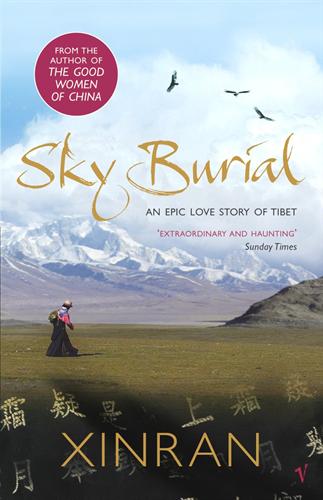
On reading Xinran's "Sky Burial"


I just finished "Sky Burial", the second book by London-based journalist Xinran, who acquired fame for her account of different Chinese women's lives in "The Good Women of China".

In "Sky Burial" she brings the story of another Chinese woman, Shu Wen, whom she met for a few short days in Nanjing, during which she told Xinran about the amazing twist that brought her to live in Tibet for 30 years.

A native of Suzhou, Shu Wen marries Kejun, an army doctor, who is sent to Tibet in the fifties and goes missing soon thereafter. Having only been married for a hundred days, Shu Wen joins the army herself and sets out on a search for her husband whom she believes might still be alive. What ensues is pretty mindboggling: she saves a Tibetan aristocratic woman named Zhuoma, gets separated from her army unit, is saved by a Tibetan nomad family and continues to live with them for nearly thirty years, in the process of which she sheds most of her Chinese identity and blends in in the Tibetan Buddhist world around her. She never gives up her search for Kejun and in the end she finds the truth revealed.

The book has been described as "Wild Swans crossed with Seven Years in Tibet" (Giles Foden in "The Guardian"). I would rather say it is "Dances with Wolves" in Tibet. Xinran presents us with the oriental version of the noble savage: it's rough land, with a rough culture, where people are struggling to survive in dignity. In that sense, the book transcends the geographical boundaries drawn by man and brings us into a world of universal values that all of us like to connect with.

The question on the authenticity of the story has also been raised several times. Maybe I have to refer to this review which in my opinion makes several valuable points.

"XINRAN's SKY BURIAL exists in that strange place where truth and fiction overlap. Some fiction, perhaps the best fiction, illuminates the truth in way mere fact cannot, while some true stories are so unique and extraordinary as to intersect less with everyday reality than most fiction.

a number of SKY BURIAL's Tibetan protagonists might very well recognize this place of blurred boundaries between what is and what might be, for it is often a place of spirituality and hope. This is just one of ironies in Xinran's account of Shu Wen's tale. The relationship between the Chinese and Tibetans is hardly the black and white affair it usually presented to be (by either side of the issue). Not all Chinese revolutionary martyrs were hypocritical propaganda constructs."


In the end it doesn't really matter whether all is based on factual truth. The fact that the boundaries between reality and fiction are very narrow at some times IS the truth and it is illustrated in this book. The account of all that is told in the book could not have entirely been revealed in the two days time Xinran had the occasion to talk to Shu Wen, so for sure fiction is used in helping to create the image of the reality. Xinran is walking the path Karl May took when he wrote about the West he had never been to, yet May's accounts were well funded in reality.

For those wanting to read the book, let there be no mistaking: it is NOT about the ritual known as sky burial (jhator in Tibetan), where the corpse of a deceased person -during life the vehicle that carries the spirit and soul of the person but merely an empty vessel after death that can be disposed of without much further ado (since the spirit leaves the body at death)- is cut up, crushed and fed to the vultures. It is a last gesture of kindness to the other living beings. Though there is a key scene describing the ritual, I believe Xinran is using this connotation of the sky burial practice as representing the selfless behaviour of Kejun and by extrapolation most of what is going on the book: it is acts of humanity that make people survive in the struggle for life, it is one living being taking care of the other that makes us come through. The title, in my opinion, therefore should not be read in any ethnographic sense or as a reference to a cruel, uncivilized world, but rather as symbolizing the opposite.

Seen from that point of view, it is a remarkable book that deserves everybody's attention. I would like to end with Peter Gordon's final remarks from the above mentionned review:

Xinran has once again written with understanding and compassion about strong women who seem to have stepped out of the pages of a novel. Shu Wen disappeared right after Xinran's copied down her story. Is SKY BURIAL true? The strength of the story is that it doesn't matter.

AddInto